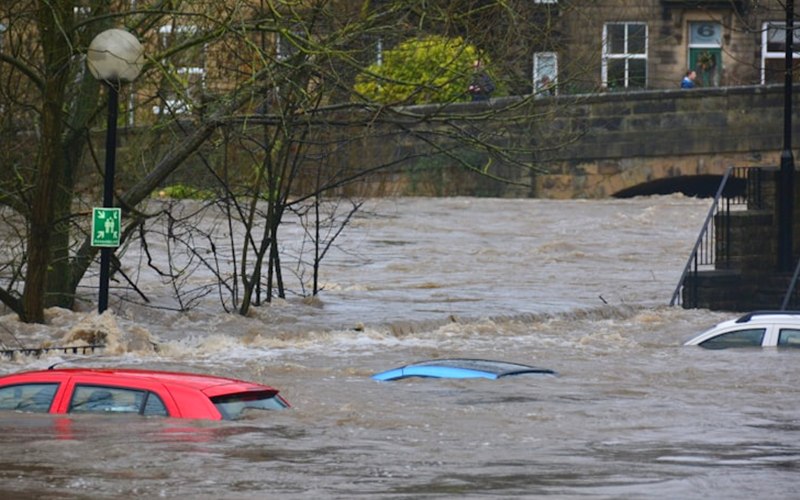
Flooding causes billions in property losses every year, yet most homeowners skip the coverage -- and many don't realize their regular policy excludes flood damage entirely. The instinct to save by going without is understandable, but it's the most expensive corner you can cut. The smarter Daily General approach is to get the protection you truly need while paying as little as possible for it. This guide shows you exactly how to strike that balance.
Why Skipping It Isn't the Saving You Think
A standard HO-3 homeowners policy does cover sudden interior water problems -- a burst pipe, an overflowing washing machine. What it excludes, without exception, is outside flooding: a river overtopping its banks, storm surge, accumulating rainfall, snowmelt runoff. No major carrier covers this.
That distinction is where families get wiped out financially. If a hurricane tears your roof and rain pours in, your homeowners policy pays. But if that same storm pushes a surge that floods your first floor, you're entirely on your own without a separate flood policy. Countless households learned this the hard way during Katrina, Harvey, and Ian, when billions in flood damage went unpaid -- a "saving" that cost people their homes.
Your Two Ways to Buy: NFIP vs. Private
Congress created the National Flood Insurance Program in 1968, run by FEMA, so homeowners in participating communities could buy flood coverage. It remains the country's largest source, with more than 5 million active policies -- and knowing how it compares to private coverage is the key to not overpaying.
NFIP Coverage Limits
The program splits coverage into two parts, each capped:
- Building coverage: up to $250,000 for the structure, covering the foundation, electrical and plumbing systems, HVAC, appliances, and built-ins like carpet and cabinetry.
- Contents coverage: up to $100,000 for belongings -- furniture, clothing, electronics, portable appliances -- purchased on top of building coverage.
- Basement limits: the NFIP keeps basement protection narrow; finished walls and floors and most belongings stored there aren't covered.
- No loss-of-use: unlike a homeowners policy, the NFIP won't pay for living elsewhere while your home is uninhabitable.
How to Tell Which One Saves You More
Private flood coverage has grown into a genuine alternative. Private insurers often offer higher limits, replacement-cost payouts instead of depreciated value, loss-of-use protection, and basement-contents coverage. Their premiums can match or beat the NFIP -- especially for homes in moderate-risk areas -- so getting a private quote alongside an NFIP one is the simplest way to make sure you're not overpaying.
One caveat: private policies aren't available everywhere, and some mortgage lenders are still warming up to accepting them toward their requirements. Confirm with your lender before swapping an NFIP policy for a private one.
Know Your Flood Zone -- It Drives the Price
FEMA maps flood zones on its Flood Insurance Rate Maps (FIRMs) to show community risk. Your zone determines both whether coverage is required and roughly what you'll pay, so it's the first thing to check when hunting for savings:
- Zones A and AE (high-risk): areas with at least a 1% annual flood chance -- the 100-year floodplain. With a federally backed mortgage here, flood insurance is mandatory.
- Zones V and VE (coastal high-risk): shoreline areas exposed to storm surge and waves on top of flooding. Premiums usually run highest here.
- Zone X (moderate-to-low risk): ground outside the 100-year floodplain. Coverage isn't required but is a smart, cheap buy -- more than a quarter of NFIP claims come from Zone X, and here a policy can cost very little.
- Zone D (undetermined risk): areas whose flood risk hasn't been studied. You can still buy a policy, but pricing reflects the uncertainty.
Elevation Certificates: A Quick Way to a Cheaper Premium
- An elevation certificate documents where your home sits relative to the Base Flood Elevation (BFE) for your zone
- A home above the BFE can earn markedly lower rates -- often paying for the certificate many times over
- A licensed surveyor typically charges $300-$600 to produce one
- Even under FEMA's Risk Rating 2.0, elevation remains a major factor in your premium
- Keep the certificate -- it stays with the property and can help the next buyer too
What Drives the Price (and Where You Can Cut It)
Flood premiums vary widely, and understanding the levers is how you lower yours. Since FEMA's Risk Rating 2.0 took effect in 2023, pricing reflects each property's individual risk more precisely than ever:
- Distance to water. Proximity to rivers, coast, lakes, and other water is a leading rating factor.
- Home elevation. Homes raised above the base flood elevation pay far less -- even a few inches can move the premium, which is why elevation work can pay off.
- Claims history. Past flood claims or a repeatedly flooded location push rates up.
- The building itself. Foundation type, number of stories, age, and whether living space sits on the lowest floor all affect the price.
- Limits and deductible. Higher limits raise the premium; a higher deductible lowers it. NFIP deductibles run $1,000 to $10,000 -- raising yours is a fast way to trim the bill if you keep the difference in savings.
A typical NFIP premium runs about $700-$900 a year, though high-risk homes can pay several thousand. In low-risk zones, the NFIP's Preferred Risk Policy can put coverage within reach for as little as $300-$500 a year -- a genuine bargain for the protection.
Don't Wait: The 30-Day Rule Can Cost You
One detail catches many homeowners off guard: an NFIP policy generally doesn't take effect until 30 days after purchase. You can't watch a storm approach, buy a policy, and expect coverage -- so buying ahead is part of getting the best value.
A few exceptions apply: coverage tied to a new mortgage can start at closing, and if a remap suddenly puts your home in a high-risk zone, you get a 13-month window to buy with only a 1-day wait.
Protect Your Payout: Filing a Flood Claim
The premium you paid only pays off if your claim is paid in full, so documentation and speed matter:
- Call your insurer immediately. Report the damage as soon as you can -- delays only complicate the claim.
- Document everything. Take plenty of photos and video before any cleanup -- waterlines, ruined belongings, structural damage.
- Set damaged items aside. Don't discard anything until the adjuster has seen it; move things to the garage or yard if needed, but keep them.
- Prevent further loss. Make reasonable temporary repairs -- board windows, tarp the roof -- and keep every receipt.
- Meet with the adjuster. They inspect and draft an estimate; review it closely and supply any extra documentation requested.
Flooding is the most common and costly natural disaster in the country. Near water or not, the goal isn't to spend the least -- it's to buy the right coverage at the lowest price, which makes flood insurance one of the smartest dollars a homeowner can spend.